Archive for the ‘Uncategorized’ Category

h1

Eccentric Toolworks Backsaws–Best New Tools

November 4, 2009

I’m very pleased and humbled that Popular Woodworking included my backsaws in their list of the Best New Tools of 2009. An incredible amount of work goes into making each saw, and it never ceases to give me satisfaction that people find them to their liking. So thanks Popular Woodworking, and congratulations to the other tool makers who made the list. It is very good company to be in.


h1

A Parable from Valley Forge

October 10, 2009

OK, so here is my last post about Valley Forge. It’s a story I’m going to share with you, partly because it was humorous, and partly because it’s the sort of thing you might read in an old book of parables but would never think actually happens. Unfortunately I don’t have any pictures to go with it, so you’ll just have to bear with me and use your imagination.

It’s sometime on the first morning of the conference. I’m at my booth in the marketplace, and there are lots and lots of people working their way up and down the aisle examining the various wares. I look to my left and a small, elderly Asian man in a purple jacket catches my eye. He is just kind of puttering along, taking very tiny steps, with his hands clasped behind his back.

Now, I am not even remotely a student of Japanese woodworking, but I thought to myself, “That looks like Toshio Odate.” I’d read his book a number of years ago, but I really just couldn’t say. It’s not someone whose image I have seen often, or for a long, long time.

So I tended to some customers and a little while later I notice this elderly man is now at a nearby booth. No one seems to recognize him or react to him, so it must not be Toshio Odate. One person is even showing him how to use a marking knife. Toshio Odate is like the Roy Underhill of Japanese woodworking–almost a saint of some kind. Surely if it were him someone would recognize him.

Not long after that, this tiny man makes his way to my table. He reaches down and touches the blade of my big rip saw. He looks at it very carefully and asks how I did the shaping of the toe, and about the way the teeth are graduated, from smaller at the toe to bigger at the heel. “Very nice,” he says. “Very nice.”

OK, so I’ve got to find out who this is. But I don’t want to look like a total idiot if it’s not Toshio Odate. So I thought I would try to feel him out a little bit. You know, be a little discreet.

“You look awfully familiar to me.”

His reply was almost instantaneous. “All Japanese look alike.”

And he made this gesture that was somehow both comic and tragic with his hands around his face.

“No, no, that’s not …” I trailed off. We both chuckled a little.

“So what classes are you doing this weekend?” I thought perhaps I could smoke him out that way, by not specifying whether he would be taking or teaching the classes.

He sighed. “Just talking a little bit.”

Aha! I knew it!

“So you’re teaching.”

He shrugged. “I don’t know if it is teaching.”

Now, did I already tell you, I’m not a student of Japanese woodworking? Well it didn’t matter in the least. I couldn’t help but feel thrilled and honored to meet this master craftsman and to have had such a good humored exchange with him. We just sort of stood there for a few seconds.

“I knew it,” I said.

To which he said nothing, but simply grinned and nodded, then turned and shuffled off.

So what’s the moral to the story? Know your famous woodworkers? Or don’t admit in your blog when you don’t know one? Or how’s about this–Many times the most talented people are also the most unassuming? Yeah, let’s go with that last one. I think I like that one best.

h1

There’s Always Gotta Be One…

October 7, 2009

And it’s usually me! The guy who is pulling pranks and trying to get people to laugh. I love a good practical joke. So this last weekend at Woodworking In America at Valley Forge, the tables were turned and I got a taste of my own medicine. Luckily for me I’m also the guy who never minds a good laugh at his own expense!

(A shot of the Benchcrafted, Brese Plane, and Czeck Edge area as it adjoined mine on the day before the show)

Woodworking In America was my first show as an actual exhibitor, and some of my buddies decided to give me a special welcome. My booth was situated right beside the space occupied by Ron Brese, Bob Zajicek, and Jameel Abraham. Jameel’s brother Father John Abraham was also there, and he’s just as ornery as Jameel. They arrived early on Thursday to set up their space, and then left. I did not arrive until later in the afternoon and was very stooped and road weary. I was just kind of shuffling along, and when I get back to my booth I look up and see this:

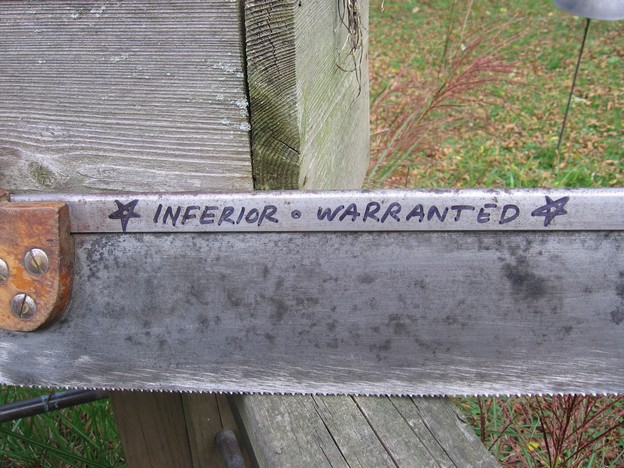
Now, I can be a bit gullible, but also being tired, my powers of b.s. detection were especially weak, so when I saw this sign I felt a bit crestfallen and thought, “Oh great. I’m on a hand scrawled sign, and they think I’m a rep for Harbor Freight.” I set down my things and shuffled over to the check-in table to ask about it. The staff at the booth thought it must have been some kind of mistake, so I just took the sign down and set up my stuff. Needless to say, Jameel, Father John, Ron, and Bob all had a very good laugh at my expense. And so did I. Especially when they found out that I’d actually gone to the check-in table to ask about it!

Periodically throughout the weekend people would stop by and ask, “Where’s Harbor Freight? I thought Harbor Freight was here.” Good stuff.

Then, just to make sure I got the full Abraham brothers experience, on Saturday when I took a bathroom break, I return to see Jameel standing near the border of our respective spaces by this donut box we’d all been plundering. He’d make a terrible poker player–he looked like a guy trying to conceal that he’d just been dealt a full house.

“Hungry?” he asks.

“I’m doing OK. Why? You hungry?” He grinned and shrugged.

“I think you got a customer.” He nodded behind me. I turn around and sure enough there is a gentleman looking at my saws. And there, tastefully displayed along with all of my other saws, is this:

Like I said, there’s always gotta be one. But in this case it was more like two, or three, or four! Did I even have a chance? I’ve already told them to be on guard, because I will hunt them down one by one just like in a horror movie and get them when they least expect it. Only instead of a hockey mask or something like that, I think I’ll wear a mosquito headnet from Harbor Freight!

h1

Woodworking In America, Valley Forge

October 6, 2009


Without a doubt Woodworking In America at Valley Forge was the place to be this last weekend. I personally did not know what to expect, as this was my first big show as an actual exhibitor. And I’ve got to say, the conference exceeded my expectations in every way. The memorable moments and highlights just seemed to go on and on.

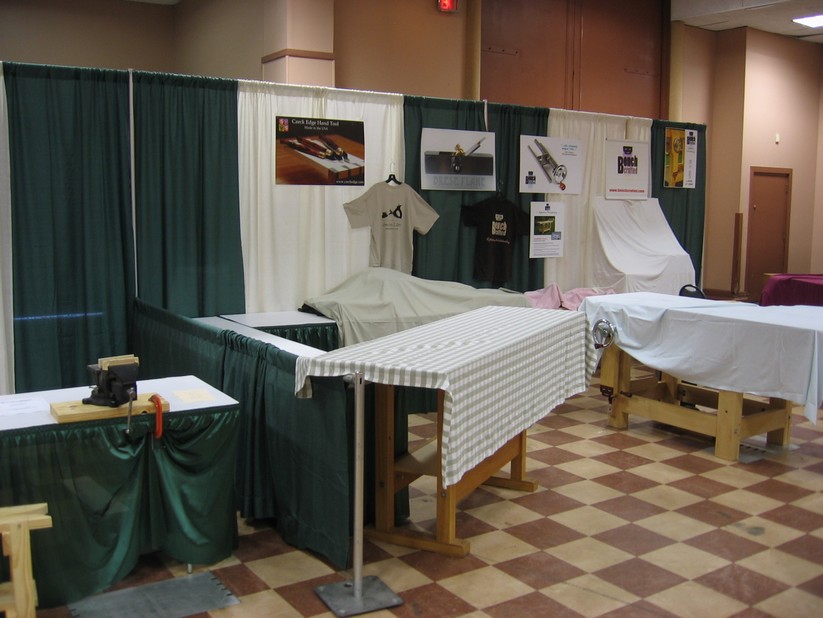
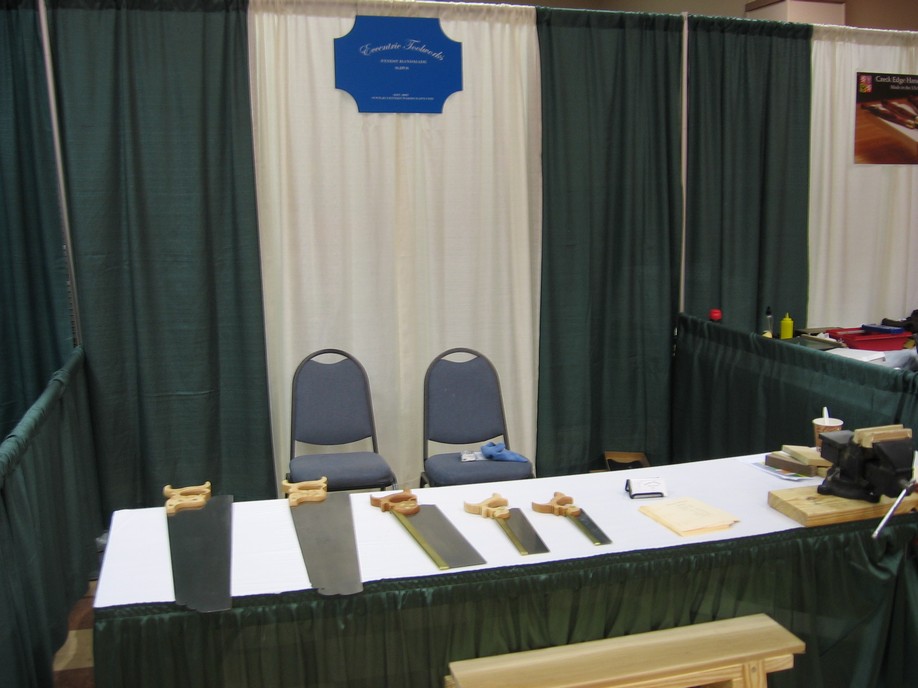
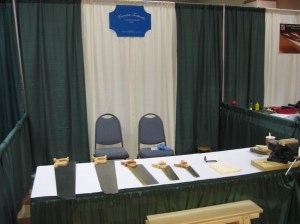
The shot above is of my booth on the first morning, before things got going. That machinist’s vise to the right, that was my makeshift solution for holding pieces of wood for people to try my backsaws, as I don’t yet have a travel bench for shows like this. However, the vise was not stable enough to use at all; the table was simply too flimsy, even with me bracing it. So my friend Jameel Abraham, who had brought his incredible workbench and Benchcrafted Vises (www.benchcrafted.com), very generously offered to let me use his bench when people wanted to try one of my backsaws. I would have been up the creek if not for Jameel’s kind offer, so thanks Jameel!


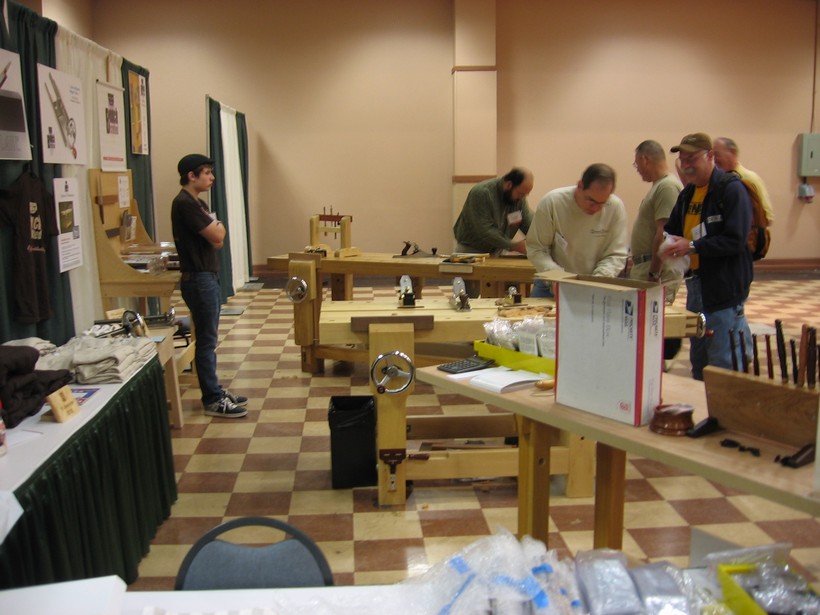
This picture above is a shot from my booth to the ones just beside me–you can see Jameel’s benches with their massive handwheel glide vises–those things are astonishingly nice. That space right there was occupied by Brese Plane (that is Ron right there wearing the light colored long-sleeved t-shirt), Benchcrafted, and Czeck Edge Hand Tools with Bob Zajicek. You can see a bit of the Czeck Edge offerings in the foreground to the right, all of those handles protruding from that block. Those were numerous marking knives and awls. Bob also had on hand his new chisels. It seemed like there was a constant stream of people there to examine and buy Bob’s tools all weekend. (www.czeckedge.com) Other people in this picture include the young man to the left, Hunna, Jameel’s nephew, and Jameel himself, the bearded guy in the background using a plane at the far bench. Hunna, by the way, was the nicest young man–just 15 years old, with a quiet smile and a kind way about him. He was a real pleasure to have around.

Here is a better shot of Ron, Jameel, Father John (Jameel’s brother), and Dan Barrett, from D.L. Barrett and Sons, makers of truly incredible wooden plow planes. From left to right that’s Dan Barrett, Ron Brese, Father John, and Jameel.


You can see some of Ron’s planes out on Jameel’s workbench. Ron, Jameel, and I have been in touch for a while now, but I hadn’t gotten to try one of Ron’s planes until this show. Wow! I’m telling you, if you ever get the chance to try one, don’t miss it. They are so smooth, a lot of the time you can hardly even feel the iron cutting. I was using his shooting board plane, for instance, where the mouth of the plane is out of site to the side, and I couldn’t feel it making a shaving, so I leaned to the side to look, and Ron chuckled, “Oh it’s cutting.” And sure enough there were these wispy thin full width shavings curling up on each other in the mouth. Ron is a very smart and understated guy, and his planes just ooze competence. (www.breseplane.com)

Here is a shot of the Barrett’s plow planes.
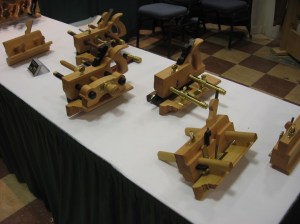

That picture won’t even do them justice. Seriously. It’s in no way hyperbolic to refer to those planes as world class work. It can start to sound almost a little fantastical when talking about all of the tools at this show–everything is so superlative. But that’s just the caliber of tools you are dealing with at a show like this. I had so many attendees tell me how much they enjoyed being able to walk around and look at all of these amazing tools. Well let me tell you a secret–the tool makers enjoy walking around and looking at the other tools just as much as the attendees do!

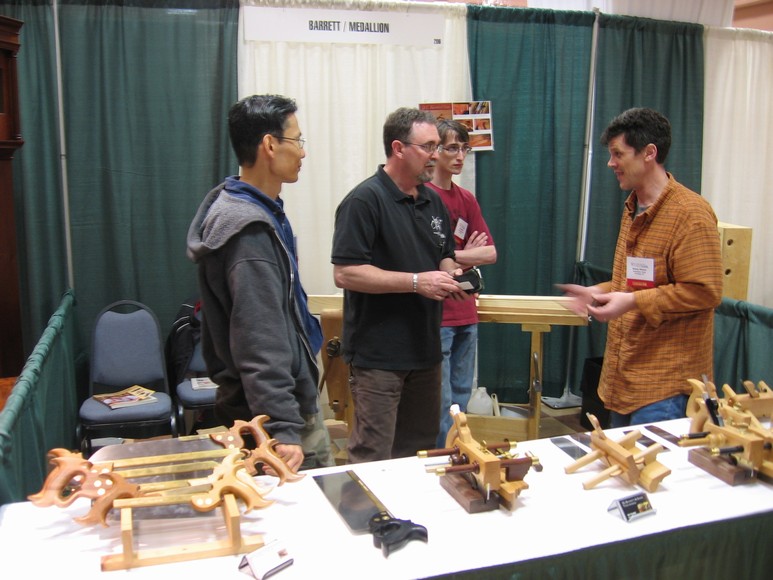
Here is a good shot of the booth shared by the Barretts and Medallion Toolworks.

The young guy standing behind Dan Barrett in the burgundy shirt, that is Kyle Barrett. Along with Dan he is instrumental in making those plow planes. Kyle is 18 or maybe 19 years old and is an incredibly bright young man. When you talk with him you find you forget how young he is and could be speaking with a gifted human intelligence of any age at all. Before we all went home on Sunday and were saying our goodbyes, I patted Kyle on the shoulder and told him to keep up the fine work–he modestly grinned and nodded. I have no doubt he will.

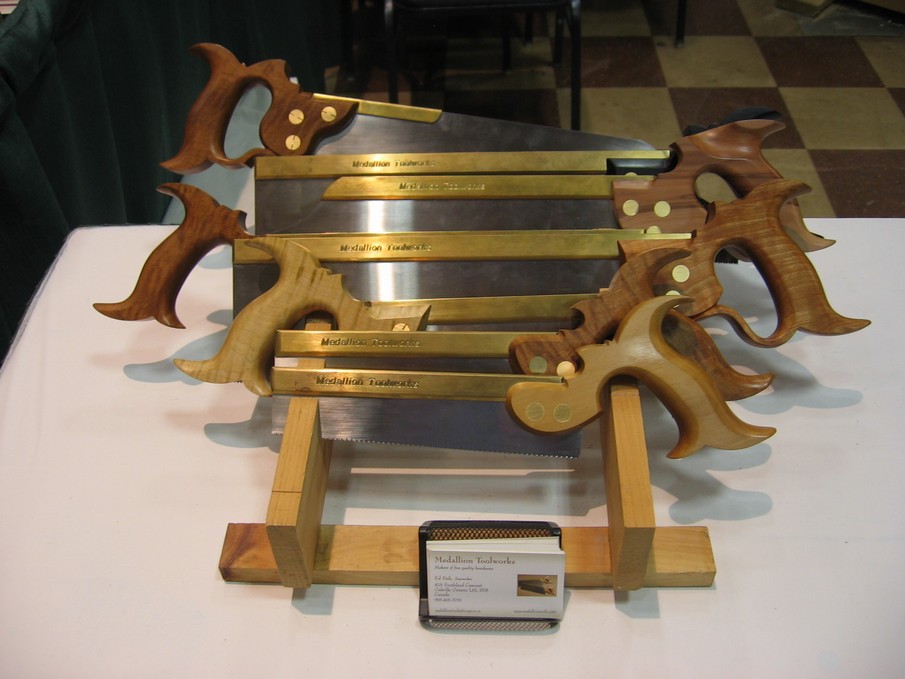
The guy to the right in the picture is Raney Nelsen, a hand tool enthusiast and a budding infill plane maker in his own right. Raney’s enthusiasm is absolutely contagious. And to the left in that picture is the saw maker Ed Paik of Medallion Toolworks. Getting to meet and hang out with Ed was a real treat–both of us being saw makers, we automatically had a lot in common, and it was more like talking with someone who might be at work at the next workbench than to someone who in fact lives hundreds of miles away. Here is a better shot of Ed’s fine saws.

There are also a lot of people and booths I didn’t get a photo of. I actually forgot to take my camera on Saturday, so that was a whole day where I was cursing my absentmindedness. And then there were other times when I just didn’t have my camera with me. I didn’t get a picture, for instance, of Konrad Sauer and his incredible infill planes. (www.sauerandsteiner.com) Wow. Just wow. Konrad is a consummate craftsman and a person of tremendous skill. It’s like just happening to be alive at the same time as Thomas Norris or Stewart Spiers.

All weekend, over and over again I found myself face to face with extraordinary, and sometimes even iconic, people. Like Roy Underhill. Roy appeared at my table seemingly out of nowhere. Here he is looking at my saws.


Someone said, “Hey Roy, you gotta try that dovetail saw.” So he did. He bent down, made a cut, and you could see his eyebrows sort of wiggle. Then he made another, and another. He liked the saw a lot and was very complimentary. It was a great honor to meet him.

I could go on and on. There are numerous tool makers I met that I did not manage to get pictures of. Thomas Lie-Nielsen, for instance, or Joel Moskowitz, or Ron Hock, Dave Jeske, or Gary Blum. It goes on and on. It was such an impressive array of people. My friend Mike Wenzloff of course was there, and I didn’t get a picture of him either.

And do you know, among all of these incredible people, it speaks to the quality of the attendees that some of the best conversations I had all weekend were with them! I really enjoyed getting to put faces to names that I already knew, or getting to meet some of the people whose paths I’ve crossed in the forums. On Friday night a number of us went out to dinner and had a terrific time, a mixture of tool makers and tool enthusiasts and craftsmen. I definitely have come away from this experience with a renewed hope for people in general. To the new friends I made, and to everyone who made this weekend such a special one for me, I really can’t thank you enough.

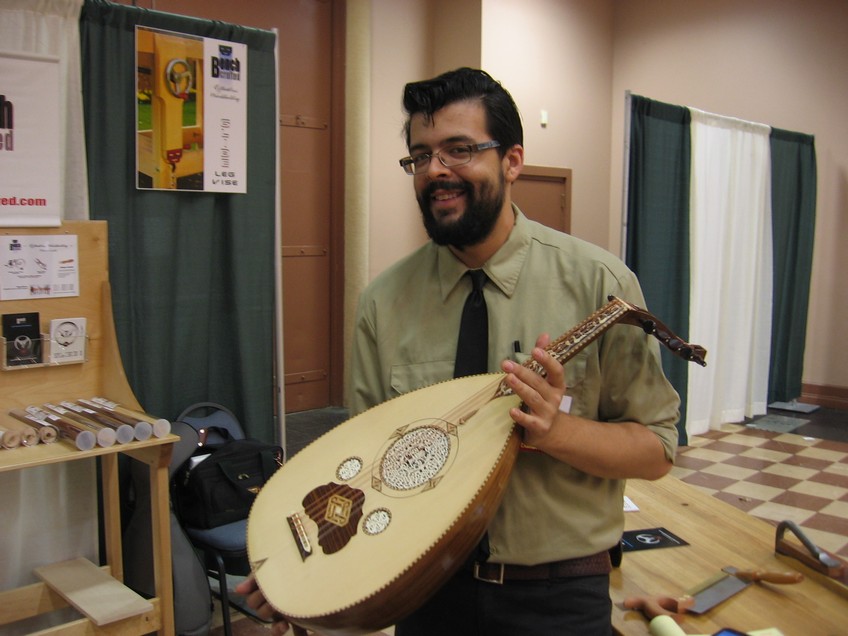
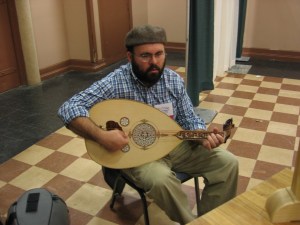
I’m going to leave with a couple images of what perhaps was the most stunning piece of work I saw all weekend–the oud that Jameel Abraham of Benchcrafted brought with him. For those of you who don’t know, Jameel not only is behind the incredible vises of Benchcrafted, he carves and builds furnishings for churches, he paints, and he is a luthier! This oud he built himself from scratch. In the picture below the oud is being held by Joel Moskowitz’s righthand man Tim, a very impressive designer and artisan in his own right.

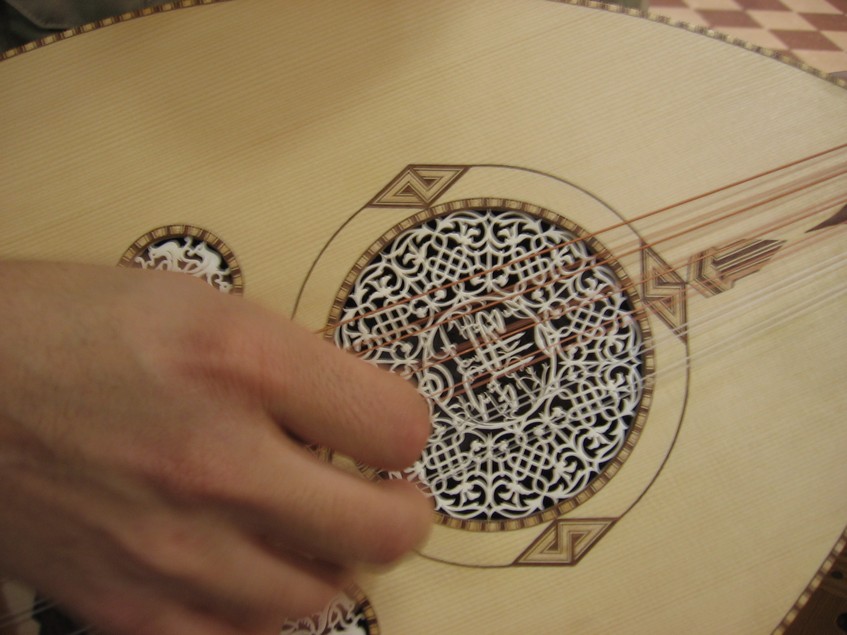
Here is a good shot of the bone fretwork at the center of the oud.

And in this last picture Jameel is playing the oud. I think I could have listened to him play all day.
h1

Woodworking in America–It’s Getting Close!

September 14, 2009

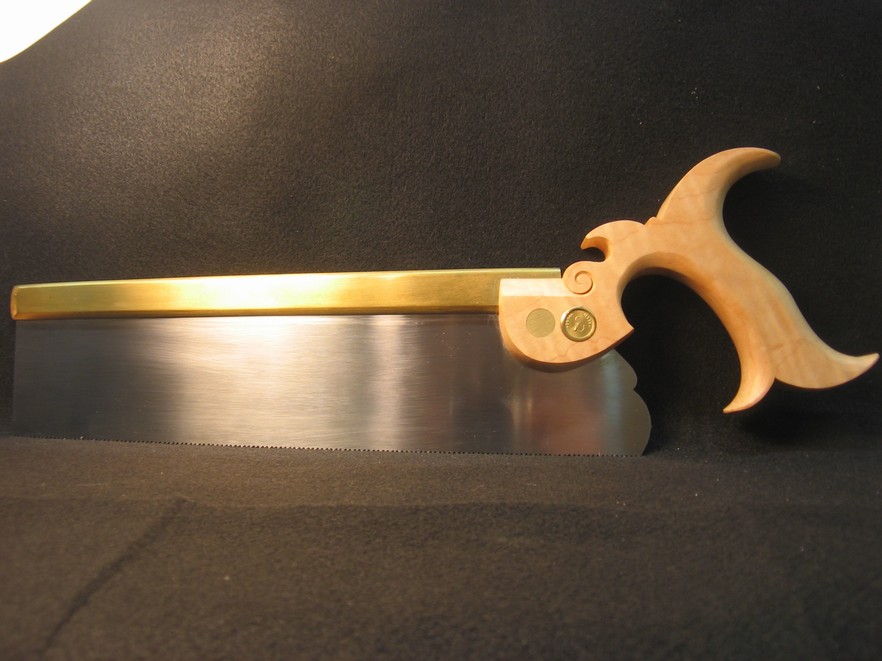
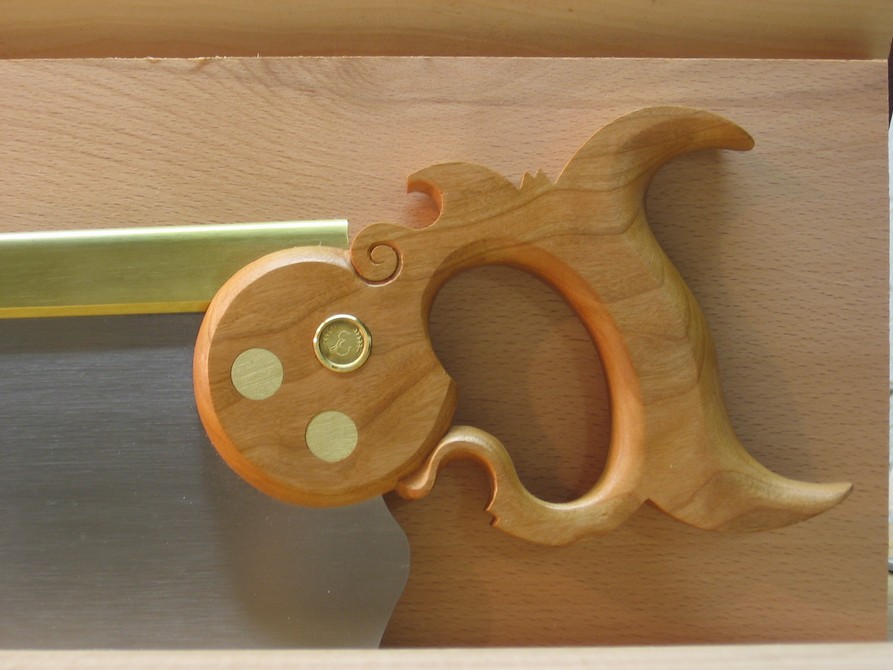
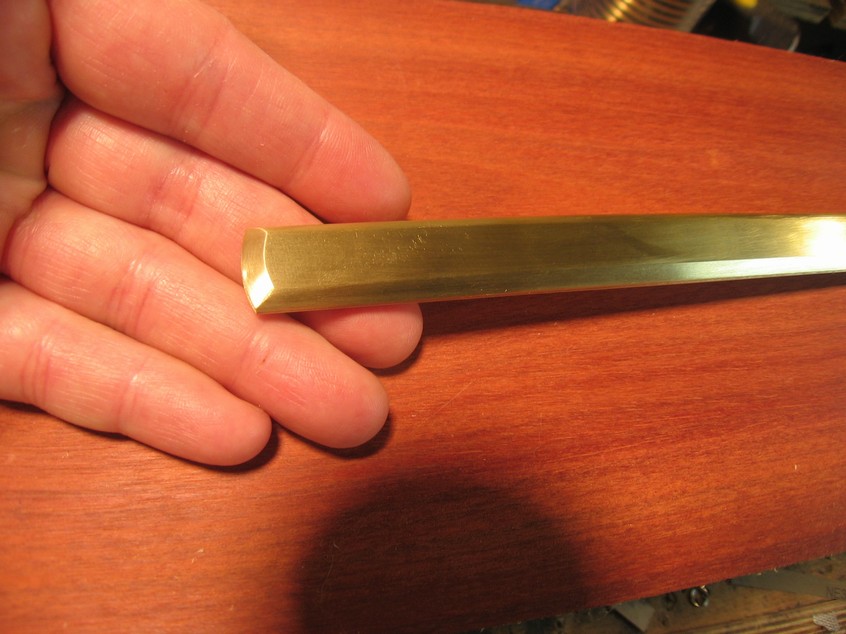
It’s almost time to emerge from the shop and step into the light of day! It’s just a week away now. If you are planning to attend the upcoming Woodworking in America conference in Valley Forge, be sure to stop by and say hi and check out some saws. I will have examples on hand of five, maybe six, of the saws I make, and you are welcome to take them for a test drive. The handle in the picture above belongs to a 16″ tenon saw that will be in attendance. I’m constantly making small refinements, as that is a big part of what makes this kind of work interesting, so the saws I’ll have with me represent my most current work. Here’s a rundown on what I plan to bring: a dovetail saw, a carcase saw, the 16″ tenon saw, a full sized crosscut handsaw, and a monster rip saw. I may have one other tenon saw as well, we’ll have to see. I will not have any saws for sale at the show, as that would not be fair to my customers who are currently waiting for their saws. But I will be taking orders. So stop by and see what it’s all about!

h1

A Gold Medal Day

August 11, 2009


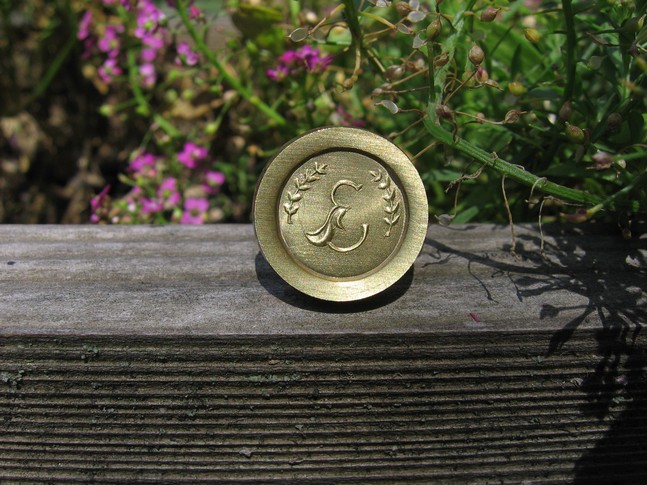
Lots of changes are taking place here at the toolworks. I’ve been developing tooling and processes for stamping my new medallions. I think a lot of people who liked the engraving will be pleasantly surprised by the medallions. They are stamped from dies that I hand engraved and don’t at all have that CNC sort of look to them. What’s more they are a raised image, not an impressed image, just like a coin, or the saw medallions of yesteryear. I personally think a raised image looks more refined than an impressed one, so I was very happy I was able to pull that one off. While saw medallions are a relatively minor part of a saw, they do impart a nice touch of character and contribute to the overall workmanship of the saw. Enjoy.

h1

A Lightbulb Moment

June 2, 2009

What do you get when you cross a guy who is absent-minded with a guy who is resourceful? No it’s not a dirty joke. OK, I’ll tell you what you get. You get a guy who keeps forgetting to buy light bulbs for his shop and has three good bulbs that he shuffles around to the various lamps. It’s the kind of thing you get used to doing and later can’t fathom how you did it. I guess I’m just very absorbed in my work. I’ll grab a bulb from somewhere and never really stop thinking about the work I’m doing. Hot potato, hot potato, hot potato. Back to work.

It’s kind of like forgetting you need to buy toothpaste until you go to brush your teeth. Each night you are transformed into some kind of serial toothpaste strangler wringing the last dregs of life from that already cashed tube of minty goo.

My wife says, “I’m making a list. Can you think of anything we need from the store?”

I look up from my sketch pad. “Yeah. We’re almost out of ice cream.”

For me to remember light bulbs instead of ice cream is like trying to overcome a million years of evolution. It just isn’t gonna happen. I think it’s a hard wired sort of thing deep within the brain. An ice cream pathway if you will, or maybe two divergent paths, one vanilla and one chocolate. Or maybe they twist?

It always amazes me that a plump fresh tube of toothpaste magically appears on my shelf in the medicine cabinet despite the fact that I never remember it. The million years of evolution that produced my wife apparently differ from the millions years that produced me. She comes from cave people who had tidy caves and orderly flints.

So maybe that is the solution. Maybe I should get my wife interested in woodworking and saw making. Have her down to the shop. Take a look around. Feign surprise that half the lamps don’t have bulbs. But you know, her giving up her sewing machine in exchange for my dirty shop is about as likely as me giving up my dirty shop in exchange for her sewing machine.

So it looks like it’s all on me. But that’s ok, because I think today might be the day that I turn over a new leaf. Yep, I can feel it. I get that warm fuzzy feeling that every caterpillar must get just before it becomes a butterfly. In fact, I’m going to sign off right now and head directly to the store. We’re almost out of ice cream.

h1

Here’s My Pitch … on Progressive Pitch

April 22, 2009

Despite my best intentions to revive my blog, about the closest I’ve come thus far is having numerous ideas for blog entries while working in my shop! So let’s see if I can do a little better. Let’s get into some saw stuff.

I recently met with a customer who asked me what I thought about progressive pitch. Most of you probably know, but for those who don’t, progressive pitch is when the teeth at the toe of the saw are finer than the ones at the heel. And they gradually progress in fineness, from their finest point at the nethermost part of the toe. You can do it so that just the first so many inches of the saw have progressively bigger teeth, before the full sized teeth are reached and obtain for the rest of the blade. That’s what you see on old rip saws. Or you can do it so the size of the teeth slightly increases down the entire blade, like you see on the Le-Nielsen progressive pitch dt saw. In either case the idea is to take stress off the toe of the saw by making the teeth smaller. Depending on how you start your cuts, this feature can make starting your cuts easier, but moreso it eases stress on the toe of the saw with every single stroke.

So what do I think about progressive pitch? That’s one of those things that you get asked a lot as a saw maker. At first blush it seems like something that would be a great idea for every saw in the universe. Easy start, easy reentry, get a big bite back near the heel, etc., etc. But like lots of things with saws, it is a bit more complicated than that once you think about it a little more closely.

Here’s the deal–to ease the cut at the toe of a saw that already has relatively fine teeth, placing yet finer teeth in front of them is not actually necessary. The teeth that are already there are fine enough that you can simply adjust their rake and achieve the effect you desire, a simpler solution to the same problem. What’s more, I find that easing the rake of the teeth is a much more sensitive way to tune the saw than messing with its pitch. Adjusting the rake gives you essentially infinite adjustability, whereas progressive pitch is kind of a one shot deal. Of course you can adjust the rake on a saw that has progressively pitched teeth, but if you are going to adjust the rake, why bother with the progressive pitch to begin with? So basically I don’t think progressive pitch is of much use for a backsaw. I just don’t think it is the best solution.

Progressive pitch actually becomes necessary when the teeth of a saw are large, and adjusting the rake of those teeth near the toe would not sufficiently ease their aggressiveness there. This is what makes progressive pitch very useful for full size rip saws. The large teeth at the toe can grab and cause the saw to bow. In fact I think progressive pitch is the perfect solution to that problem.

You might wonder, then, what if you made a backsaw that had pretty large teeth near the heel and had tiny teeth at the toe. Maybe you could get the best of all worlds–an easy start and a super aggressive and fast cutting saw. Well, here’s one thing that is very true about saws–they are extremely symbiotic tools, in that all of the elements in a given saw affect each other and need to exist in a kind of balance. So with big teeth, that means that the work done by the saw is going to be divided among fewer teeth, and therefore it will place greater strain on each tooth—-and therefore bigger teeth require a thicker plate to support the bigger teeth. Big teeth on a thin plate can make the blade buckle or distort. How much thicker does a plate have to be to support bigger teeth? I don’t know, thicker than I want to use. On tenon saws, the backsaws with the largest teeth, I still find adjusting the rake to be a superior way to tune the saw.

And lastly, I’ve seen the idea floating around out there that modern saw makers don’t do progressive pitch simply because the vintage machinery they use to tooth their saws does not do it, and the makers let the machinery dictate the design of their saws. I can’t speak for everyone of course, but for me at least that is nonsense. For most saws, there are far better reasons not to do progressive pitch than that.

(Please Note: Chris’ question below is based upon a previous draft of this entry in which my thoughts were not as clearly stated. After answering his question and rereading my entry, I decided it would be best to edit the entry for clarity as opposed to leaving it the way it was and leaving so much clarification in the comments.)

h1

The New Guy

February 12, 2009

The first day at a new job can be a little stressful, you know. New guys stick out like sore thumbs. They just have that look about them–they’re a little too eager, a little too clean somehow, a little too crisp and fresh looking. And they nearly always pay too close attention to everything, because they don’t yet know what to pay attention to.

So the other day was my first day on the job making saws full time.

Not exactly a new job, and yet when I showed up for work that day (i.e., went downstairs to the shop!) things definitely felt a little different. Hmmmm. At first I thought it might be the intense quiet the shop sometimes has before I start working, before the sounds of metal and wood being shaved away fills my ears.

But no. That wasn’t it. Hmmm. Well maybe it was the light. The light coming in through the block windows in the morning sometimes imparts an improbably lyrical quality to the cluttered and messy benches. And that morning the benches were quite … lyrical.

But nope, that wasn’t it either. I walked over and picked up a half finished brass back for a dovetail saw I was working on and just kind of weighed it in my hand. It was right at that stage where the brass really starts coming to life, where all roughness is filed away and nice bold chamfers are filed in. I love that stage. It’s like watching a tiny sunrise. Hmmm. My thoughts wandered.

What had changed was me. Working for myself in my shop was something I had wanted to do for a long time, and now here I was. In a sense I was the new guy at work again, and yet I was the old guy too. OK, I was the only guy! It made for some boring gossip at the water cooler, let me tell you. (“Hey, did you hear about Andrew?”) But there in the shop that morning was that moment of release when something you have worked toward for a long time is finally at hand. Moments like that often bring with them the feeling of, “Well what do I do now?”

So do you know what I did? I walked back over, weighed that brass back in my hand again, and lost myself in the rhythmic, solitary work of the artisan saw maker. Life just couldn’t be better.

h1

A Case for Embellished Tools

February 11, 2009


“Convictions are more dangerous than lies.”–Friedrich Nietzsche

I don’t know if I’d go so far as to call it divisive, but too embellishment is a topic that tends to occasion some strong opinions. The might seem odd, but we’re not just talking about surface decoration–we’re talking about how each of us defines a fine tool. Some people have a very singular definition of what constitutes a fine tool. It usually goes something like, “Tools are tools, and serious tools are serious–give me function and traditional details.” It’s not an uncommon attitude, as here in the states, and in Great Britain, our tool making traditions do not involve much embellishment–embellishment is more of a European feature.

My own definition of a fine tool is more fluid than it is singular–in fact I don’t really have a fixed definition. Nothing prescriptive anyway. I rather like to think there is room for creativity, and for additional layers of craftsmanship. It’s not as though there is a fixed amount of care than can go into a tool, and that embellishment must necessarily detract from a tool’s function. And yet it’s not uncommon to encounter attitudes that imply exactly that, that an embellished tool is perhaps not as serious as a tool that sticks to the old formulas, that embellishment necessarily occurs at the expense of function. Thoughts like that can be very ingrained, and perhaps that very fact is why an attitude can persist that makes no real sense once you think about it. Why would embellishment necessarily take away from function? I myself am obsessed with function.

Perhaps you could say that function getting shortchanged is simply what tends to happen. I can’t argue with something like that–maybe it is true, maybe it isn’t. I really don’t know. I can’t argue for all embellished tools from all time. I merely want to speak for my own tools, and to point out that embellished tools are no more identical in their nature than are unembellished tools. In my estimation a tool needs to be judged on its individual merits. Generalizations are rarely actually true, and yet they have a particular allure. Perhaps they reflect our desire that the truth be simpler than it is.

If we value craftsmanship in our tools, then surely there is room to appreciate additional layers of craftsmanship. That’s what embellished tools are to me, additional layers of care and thought built right into the tool. It’s not about glitz–it’s about harmony and satisfaction in one’s work. I love my work. I think we work more carefully with fine tools–I hope in some small way that my work enhances the work of those who own my tools.

So what is a fine tool? It really comes down to a matter of taste and opinion. It’s something everyone must decide for him or herself. No doubt function is foremost–how could it not be? It’s a tool! But beyond that what we have to guide is not nearly so concrete. Maybe that is a little unsettling. Or maybe it is a little exciting. Or maybe it is a little bit of both.

Design a site like this with WordPress.com
Get started